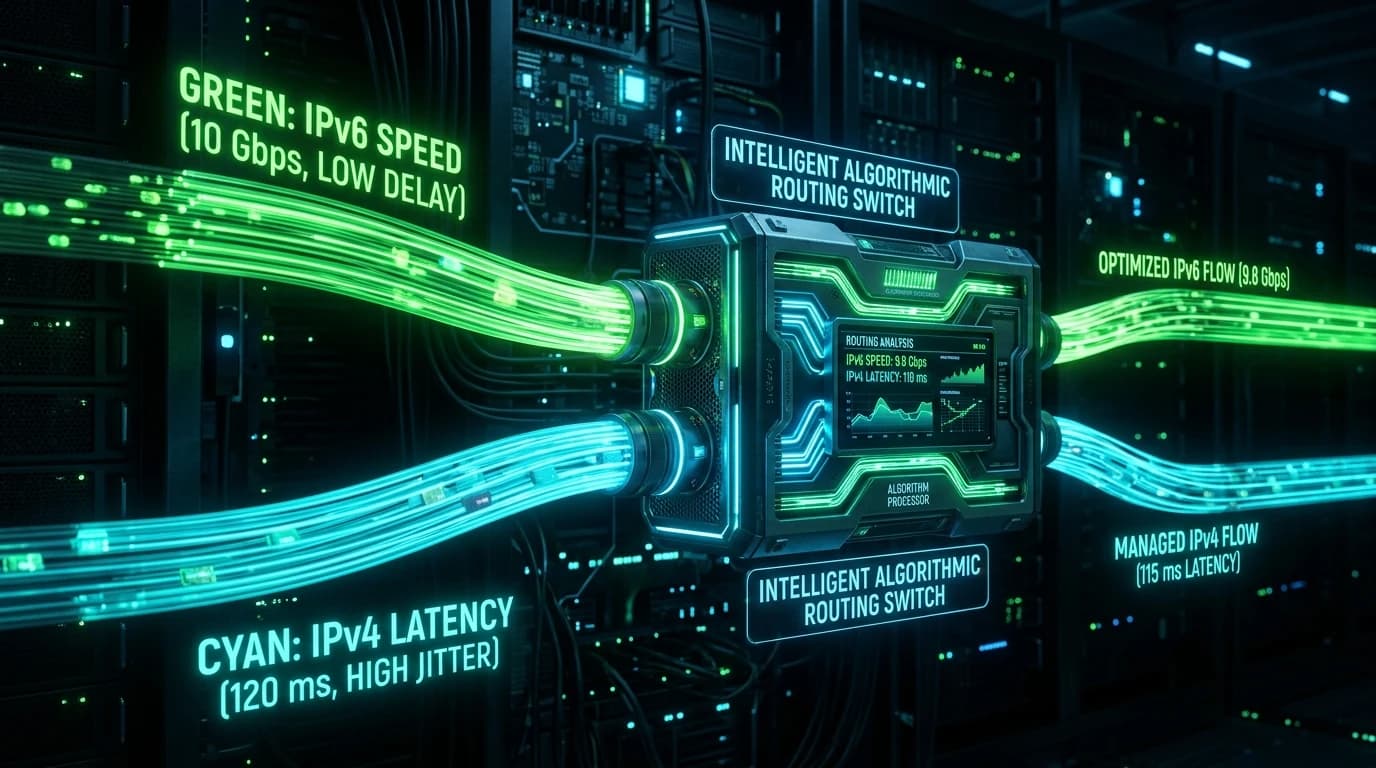
The Dual-Stack Transition Era of the Internet
Modern internet service providers, mobile carriers, and websites operate in a Dual-Stack Environment where devices possess both a 32-bit IPv4 address (e.g., 198.51.100.1) and a 128-bit IPv6 address (e.g., 2001:db8::1). When you open a webpage, how does your browser decide which protocol to use?
The Problem: Broken or High-Latency IPv6 Tunnels
In the early days of IPv6, if a network had misconfigured IPv6 routing or broken 6to4 tunnels, user browsers would wait up to 30 seconds for an IPv6 connection to time out before falling back to IPv4—creating an unacceptable user experience.
The Solution: Happy Eyeballs Algorithm (RFC 8305)
To eliminate connection delays, the IETF standardized the Happy Eyeballs Algorithm implemented in all modern browsers (Chrome, Firefox, Safari) and operating systems:
- Parallel DNS Queries: The client queries both DNS
A(IPv4) andAAAA(IPv6) records simultaneously. - Preferred IPv6 Handshake: The client initiates a TCP connection over IPv6 first.
- The Connection Head Start (~250ms): If the IPv6 handshake does not complete within a configurable delay (typically 250 milliseconds), the client fires a parallel IPv4 TCP handshake.
- Winner Takes All: Whichever protocol completes the TCP 3-way handshake and TLS negotiation first is selected for the HTTP session; the losing connection is gracefully closed.
Why IPv6 Is Usually Faster for Gaming & Streaming
Because IPv6 eliminates Carrier-Grade NAT (CGNAT) address translation layers, direct point-to-point routing over IPv6 often reduces latency by 5ms to 20ms compared to congested legacy IPv4 paths.
Explore our breakdown on Carrier-Grade NAT (CGNAT) vs public IPv4 addresses.
Instantly check your active IPv4 and IPv6 connection status on our free online dual-stack IP scanner.