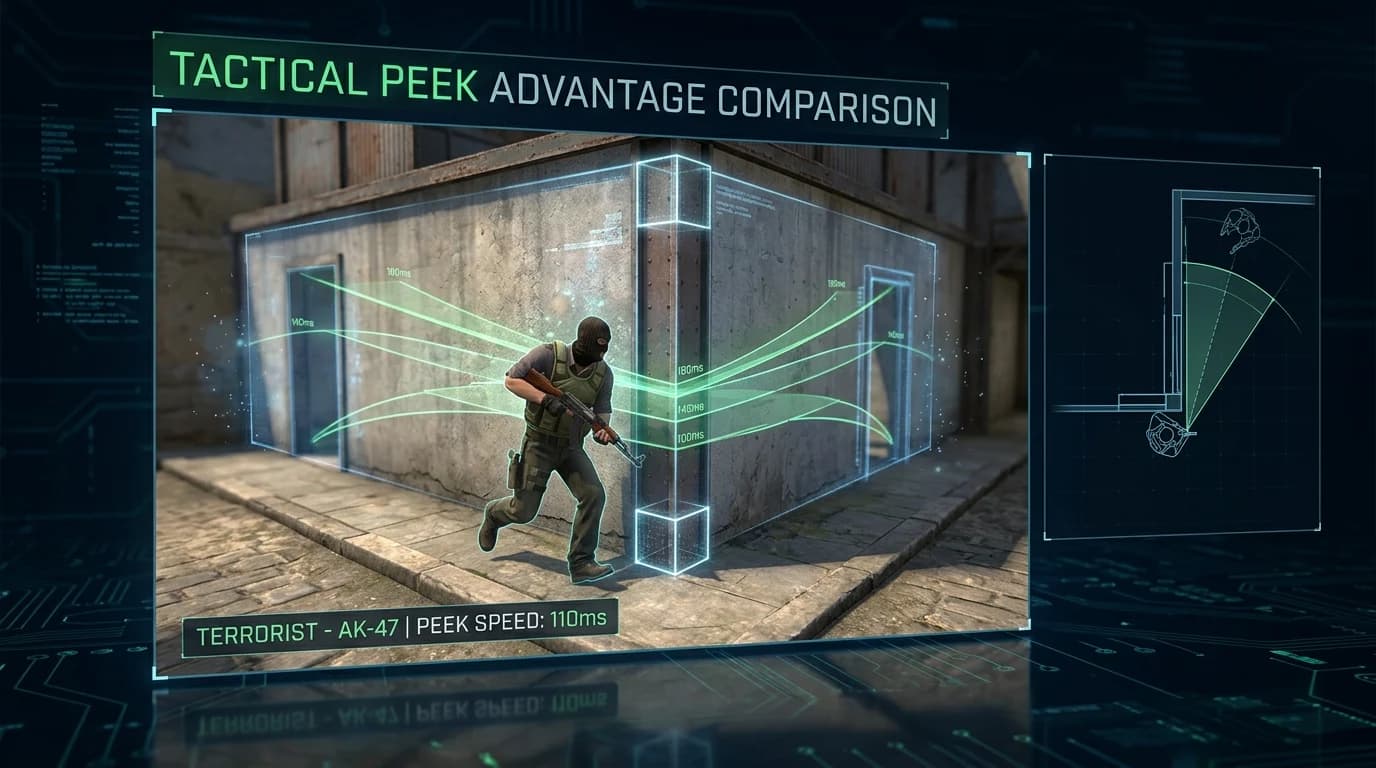
The Physics Behind Peeker Advantage
In competitive first-person shooters like Counter-Strike 2, holding a static angle against an aggressive peeker frequently feels impossible. The peeker rounds the corner, sees your character, shoots, and kills you before your screen renders their model stepping out. This is not a glitch—it is the direct consequence of Round-Trip Network Latency.
The Mathematical Latency Breakdown
- Client Prediction: The attacker presses
Dto strafe right. Their local client moves them instantly with 0ms visual delay. - Upstream Packet Travel: The movement packet takes time to travel from the peeker PC to the game server (e.g., 30ms ping).
- Downstream Packet Travel: The server processes the movement and forwards the update to the defender PC (e.g., another 30ms ping).
- Interpolation Buffering: The defender client buffers the packet by 15ms-20ms to ensure smooth animation rendering.
- Total Advantage Window: The peeker sees the stationary defender 75ms to 90ms before the defender screen displays the peeker model.
How Sub-Tick Architecture Affects Swing Fights
In CS2, while sub-tick ensures exact shot registration timestamps, visual model rendering still obeys network travel times. Aggressive wide-swinging exploits this delay maximally. Learn more in our breakdown of CS2 sub-tick interpolation and lag compensation.
Measure your real-time network latency and check your ISP routing on our free online IP scanner.