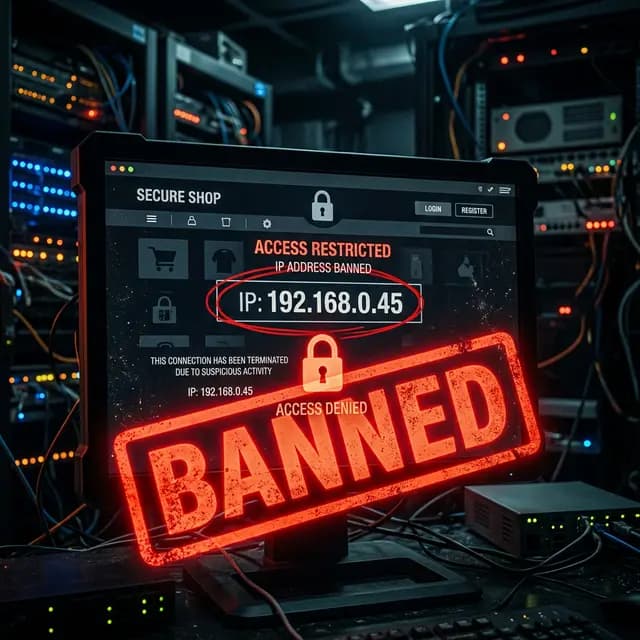
The Infinite Suspension Loop
Selling on giant marketplaces like Amazon FBA, eBay, Shopee, or Mercado Libre requires strict compliance. If your metrics drop or you violate a policy, your storefront is abruptly terminated.
The immediate reaction of most sellers is to open a "stealth" account using a spouse's name, a different LLC, and a new bank account. Yet, they are baffled when the new account is suspended within 24 hours under a "Linked Account Violation." The marketplace knows exactly who you are, primarily through network graphing.
The Web of Network Linking
Marketplaces do not rely on a single verification point. They build a multi-dimensional graph of Shared Identifiers. If an algorithm finds a "dirty" node (your previously banned account), it instantly taints any new account that touches the same node.
- The Static IP Trap: If you use your home Wi-Fi to run your new clandestine account, the marketplace logs the Public IP Address. It instantly recognizes that this exact IP was formerly used 200 times a day by the banned seller. The new account is flagged.
- The "MAC Ping" Local Storage: Using their mobile Seller Apps is a death sentence for stealth. Apps pull the physical MAC address of your phone and router. Even if you use a VPN, the physical hardware IDs remain identical.
- Deep Browser Footprints: Simply logging out and opening an "Incognito Window" does not hide you. Marketplaces rely heavily on deep Canvas Fingerprinting and WebGL rendering paths to link machines.
Operating Independent Ecosystems
Professional e-commerce agencies that legally operate dozens of independent storefronts (to avoid cross-contamination if one brand fails) must create hermetically sealed digital environments.
This involves never logging into Store A and Store B from the same internet connection. They utilize dedicated physical routers or high-quality 4G proxies strictly assigned to a single storefront. Furthermore, the physical hardware must be segregated, or else masked using an intricate Antidetect Browser architecture.
A single slip-up—accidentally checking Store B's dashboard while connected to Store A's IP address—permanently links the two accounts in the marketplace's database forever. Use our IP address lookup tool before ever authenticating a seller dashboard to ensure your environment is clean.