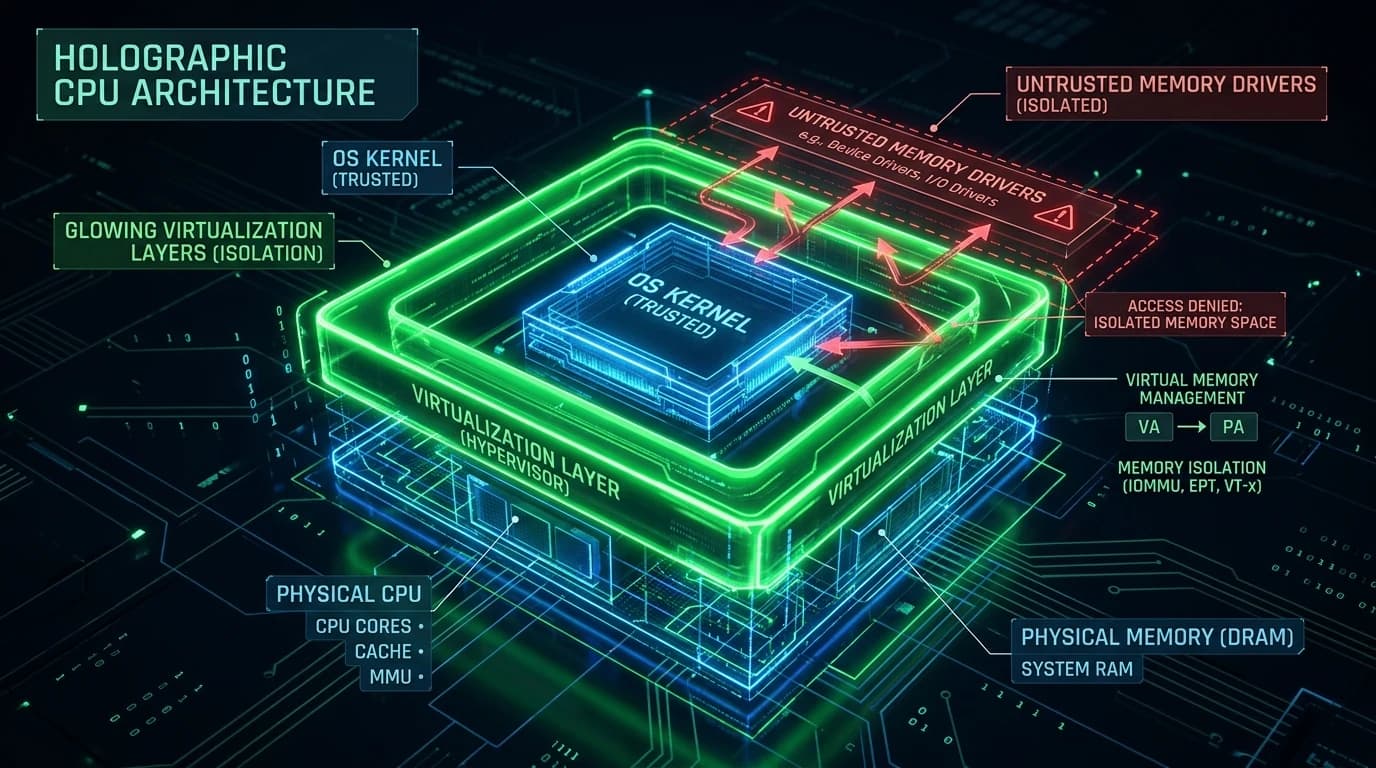
The Shift to Virtualization-Based Security (VBS)
For decades, administrative users in Windows could bypass driver signature enforcement (DSE) using vulnerable signed drivers (BYOVD exploits). To permanently close this vector, Microsoft introduced Virtualization-Based Security (VBS) and Hypervisor-Protected Code Integrity (HVCI), now mandated by competitive anti-cheats on Windows 11.
How HVCI Prevents Kernel Code Injection
Under standard Windows architecture, the OS kernel runs at Ring 0. When HVCI is enabled:
- Virtual Secure Mode (VSM): The CPU hardware hypervisor splits system memory into two isolated virtual trust levels: VTL0 (Standard Windows OS) and VTL1 (Secure Kernel & Isolated User Mode).
- W^X (Write XOR Execute) Memory Enforcement: In VTL1, memory pages can either be writable or executable, but never both simultaneously. An attacker cannot write executable cheat code into kernel RAM.
- Hardware Code Attestation: Any kernel driver attempting execution must be verified against Microsoft WHQL cryptographic signatures by the hypervisor before CPU execution is permitted.
Why Anti-Cheats (Vanguard / FaceIT) Require HVCI
With HVCI active, cheat developers cannot load custom rootkits or patch Windows kernel callbacks without immediately triggering a hardware Virtualization Fault. Learn more in our deep dive on Type-1 vs Type-2 Hypervisor anti-cheats.
Audit your system network profile and test your connection security on our Pro Cyber Shield platform.