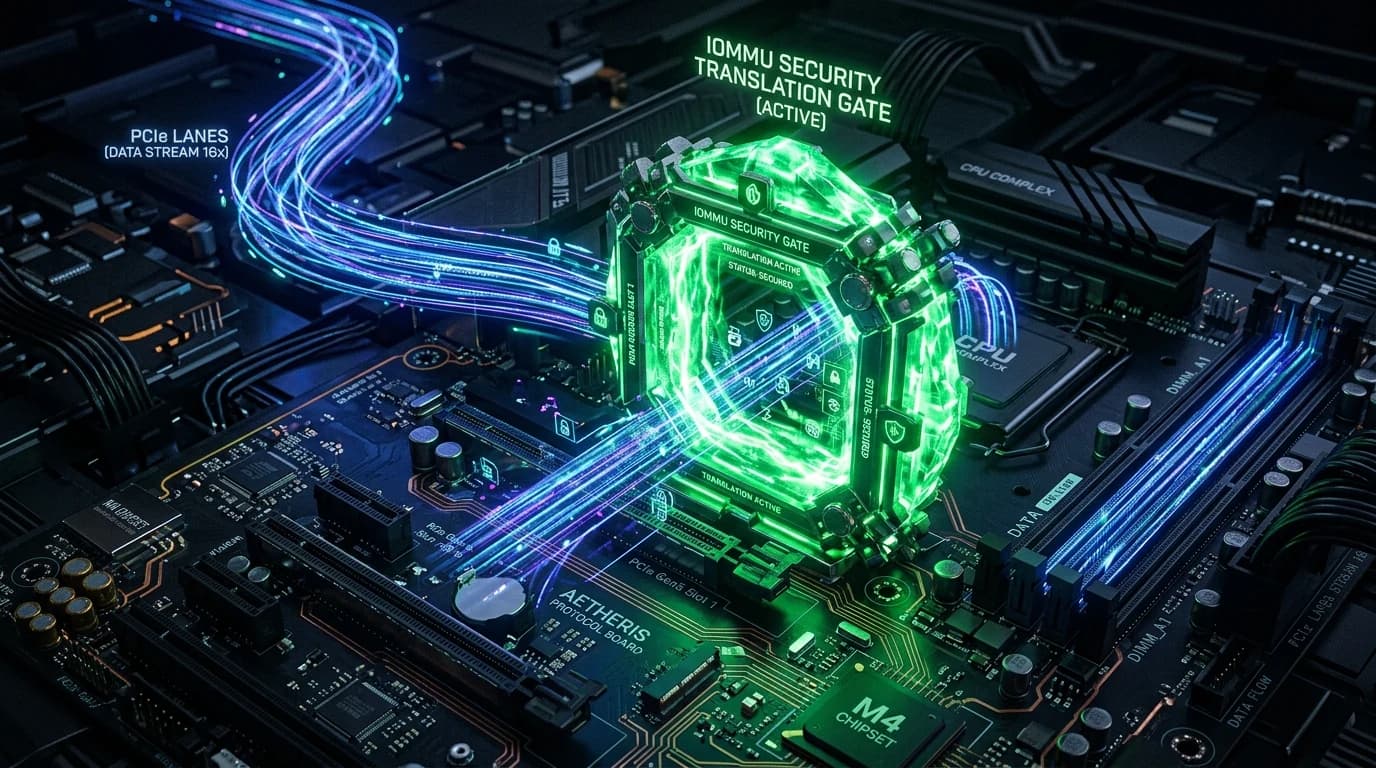
The Hardware Vulnerability of Direct Memory Access
By architectural design, the PCI Express (PCIe) bus gives hardware peripherals direct, unhindered access to system RAM to enable low-latency graphics rendering and fast NVMe storage transfers. However, cheat hardware developers exploited this by plugging PCIe DMA cards into secondary computers to silently read game memory.
How IOMMU (Intel VT-d / AMD-Vi) Enforces Memory Isolation
The Input-Output Memory Management Unit (IOMMU) operates as a hardware memory translation unit situated between the PCIe bus and system RAM:
- Hardware Page Table Remapping: Instead of allowing a PCIe device to read any physical RAM address directly, IOMMU restricts device access strictly to pre-authorized Virtual Memory Addresses mapped for that specific peripheral.
- Blocking Unauthorized Memory Ranges: When an unauthorized PCIe card attempts to read memory pages assigned to game executables or anti-cheat drivers (
vgk.sys,EasyAntiCheat.sys), the IOMMU controller drops the transaction at the chipset hardware level. - Zero Performance Impact on CPUs: Because memory remapping is handled entirely in motherboard silicon, CPU frame rates in gaming are completely unaffected.
How to Enable DMA Kernel Protection in Windows 11
- Enter Motherboard BIOS → Enable Intel VT-d or AMD IOMMU.
- In Windows 11, open Core Isolation settings → Enable Memory Integrity (HVCI) and Kernel DMA Protection.
Read our report on Tarkov 2nd-PC DMA radar cheats.
Audit your system network profile and verify your outward telemetry on our Pro Cyber Shield platform.