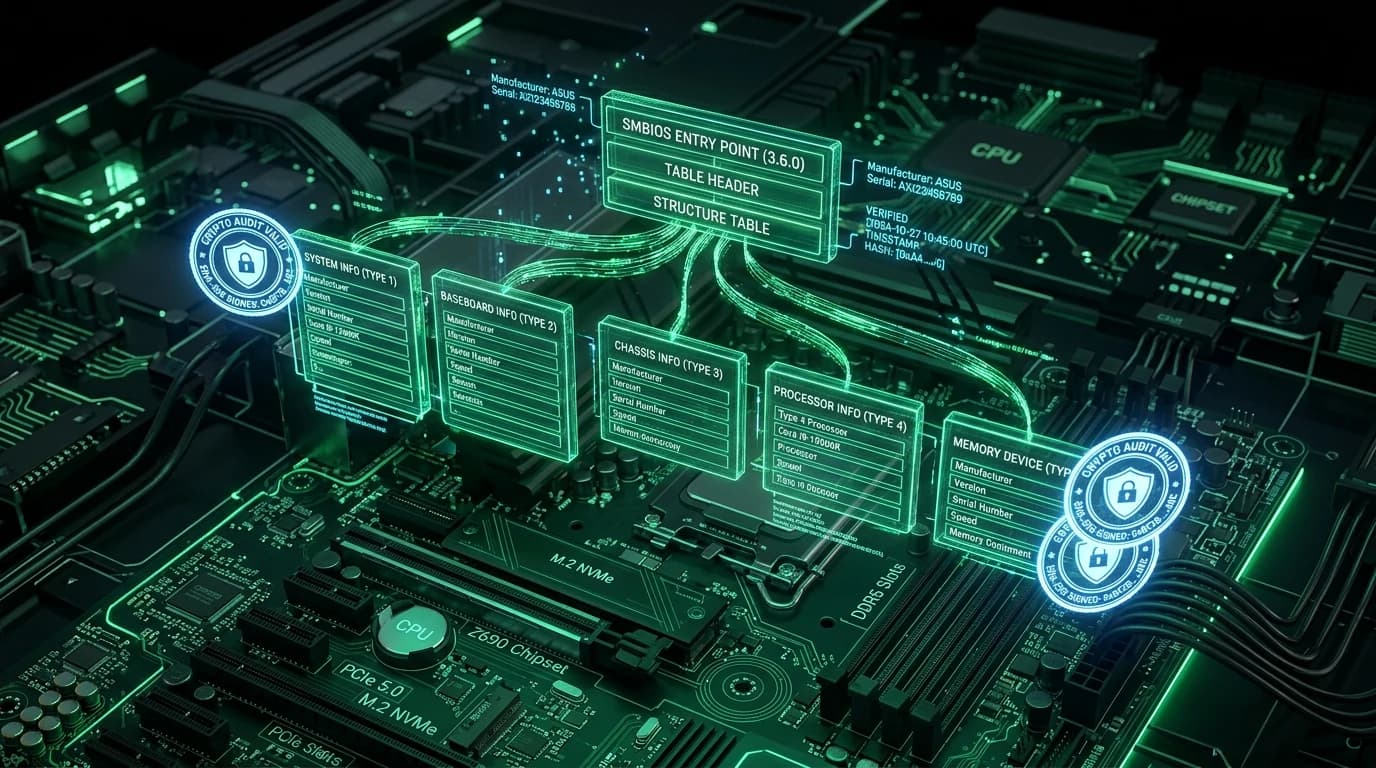
The Structure of Motherboard SMBIOS Tables
The System Management BIOS (SMBIOS) specification defines data structures stored in motherboard non-volatile RAM that describe physical computer hardware. When kernel anti-cheats (Vanguard, EAC, BattlEye) calculate hardware ban identifiers, they parse multiple discrete SMBIOS Table Types.
The Key SMBIOS Table Types Audited
| SMBIOS Type | Table Name | Hardware Data Captured |
|---|---|---|
| Type 0 | BIOS Information | Vendor (ASUS/MSI), BIOS Release Date, ROM Size |
| Type 1 | System Information | Manufacturer, Product Name, System UUID, Serial Number |
| Type 2 | Baseboard (Motherboard) | Motherboard Serial, Asset Tag, Board Version |
| Type 3 | System Enclosure / Chassis | Chassis Type, Chassis Serial Number |
| Type 4 | Processor Information | CPU Socket, Core Count, Processor ID / Microcode Hash |
How Incomplete Spoofers Trigger Instant Permanent Bans
Amateur spoofers modify only the Type 1 System UUID while leaving the Type 2 BaseBoard serial identical, or inject strings with invalid null terminators (e.g., "Default string" or "To be filled by O.E.M."). Anti-cheat heuristic engines flag these inconsistent table structures immediately.
Review our analysis on the severe risks of motherboard BIOS DMI spoofing.
Audit your network connection security and check your outward IP on the DCIPCHECK intelligence portal.