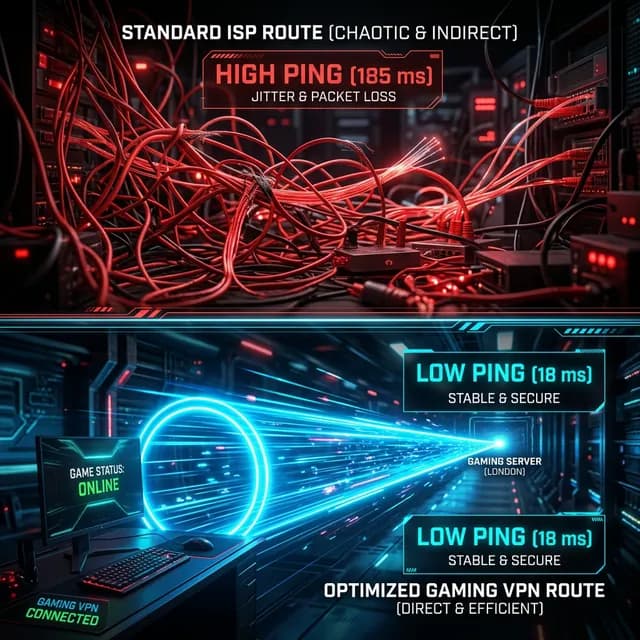
The Ping Paradox
You live in Chicago. The League of Legends servers are also in Chicago. By all laws of physics, your ping should be 9ms. Yet, when you log into the game, you are stuck at an unplayable 85ms, while your neighbor across the street gets 12ms. What is happening?
The answer lies in how your Internet Service Provider (ISP) physically routes your IP traffic. Massive telecommunication companies do not care about your video game latency; they care about saving money.
The Problem: BGP (Border Gateway Protocol)
When you send an action to the game server (e.g., clicking to shoot), that data packet must cross several physical routers to reach its destination. ISPs use routing algorithms designed to find the cheapest path, not the fastest path.
- The ISP Detour: Your packet might leave Chicago, travel down a cheap fiber optic line to Atlanta, bounce to a partner network in Dallas, and finally route back up to the game server in Chicago. This needless 2,000-mile detour creates massive ping spikes and packet loss.
- The Last Mile Issue: Your neighbor might use a different ISP that happens to have a direct "peering" agreement with Riot Games, resulting in a perfectly straight, local connection.
The Solution: The Gaming VPN
Enter "Gaming" or "Gamer" VPNs (like ExitLag, WTFast, or NoPing). Unlike privacy VPNs designed to hide your identity, Gaming VPNs are designed to act as private cyber-highways.
- When you activate ExitLag, the software forces your game data to ignore your ISP's cheap, chaotic routing table.
- Instead, your data enters the Gaming VPN's private, highly optimized server network almost immediately after leaving your house.
- The software calculates the absolute shortest, most direct physical path to the game server, bypassing ISP traffic jams and congested nodes.
The Verdict: Is it a Scam?
No, it is not a scam, but it is highly situational.
If your ISP already provides excellent, direct routing to the game servers, a Gaming VPN will do absolutely nothing for you. In fact, adding a middle-man server might even increase your ping by 1-2ms.
However, if you suffer from random packet loss, if you live in South America trying to play on US-East servers, or if your local ISP is notorious for terrible routing (creating the "Chicago-to-Dallas-to-Chicago" effect), a Gaming VPN is a mathematical necessity to play competitively.
You can use network diagnostic tools combined with an free IP address lookup to see exactly how many hops your connection is taking before deciding to purchase a gaming network subscription.