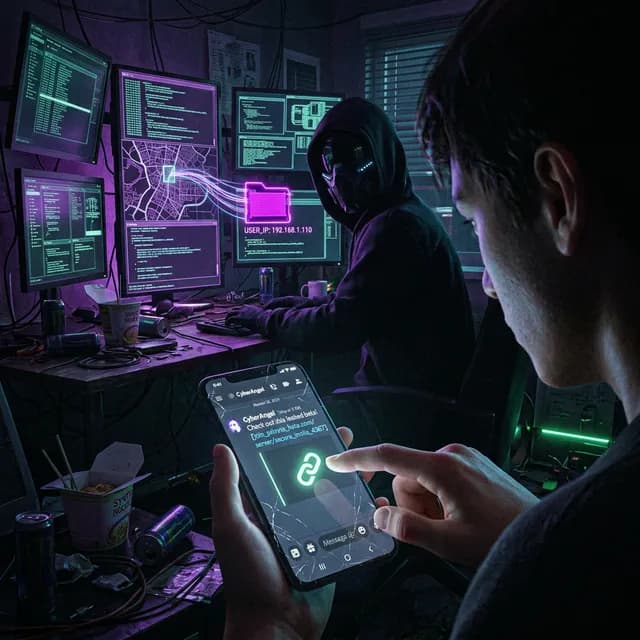
Short answer: someone can log your IP address if you click a link they control and your browser loads a page from their server. They cannot get it from a message you merely scrolled past, from an image preview inside Discord, or from a normal voice call. Most of what circulates about "Discord IP resolvers" is false, and the distinction matters — it tells you what to actually worry about.
What an IP grabber really is
An IP grabber is not a virus, an exploit, or a hack. It is a web server with logging turned on. Every HTTP request carries a source IP address, because that is the return address the server needs in order to send anything back. There is no version of the web where you fetch a page and the server does not learn where to deliver it.
Services like Grabify, IP Logger and BlastMyIP wrap this in a friendly interface. The attacker pastes a real destination — a YouTube video, a meme, a Google Doc — and receives a short link on a domain they control. When you click it, three things happen in roughly 200 milliseconds:
- Your browser opens a TCP connection to their server and sends a
GETrequest. - The server writes a log line, then answers with
302 Foundand the real destination. - Your browser follows the redirect. You see the meme. Nothing looks wrong, because nothing went wrong — the web worked exactly as designed.
What gets written in that log line
More than people expect, and less than they fear. A standard grabber records:
- Your public IP address — IPv4, IPv6, or both if your connection is dual-stack.
- A geolocation guess derived from that IP: country, region, city, and the ISP or hosting company that owns the address block.
- Your User-Agent string: browser, version, operating system, and often whether you are on mobile.
- The Referer header, which can reveal which site or app sent you.
- Timestamps, and a per-visitor token so repeat clicks from the same person are grouped.
- If the landing page runs JavaScript before redirecting: screen resolution, timezone, installed fonts, GPU string and language — a browser fingerprint that survives an IP change.
What it does not record: your name, your street address, your phone number, your Discord password, or anything on your device. An IP address is an assignment from your ISP, not an identity document. Mapping it to a person requires a court order served on that ISP.
The myths worth killing
This is where most guides on this topic get it wrong, so be precise:
Image previews in Discord do not leak your IP
When someone posts a link, Discord does not have your client fetch the thumbnail from the original host. Discord's own infrastructure fetches it server-side and re-serves it through media.discordapp.net and images-ext-1.discordapp.net. The grabber's server sees a request from a Discord data center in the United States, not from your home connection. That is why grabber dashboards fill up with Discord's crawler IPs — the operator is looking at their own proxy hits, not at you.
The practical consequence: seeing a suspicious link in a channel is not an emergency. Clicking it is a different matter.
"Discord IP resolvers" that work from a user ID are scams
Search results are full of tools claiming to return an IP from a Discord username or user ID. They do not work, and they cannot work. Discord relays all voice and video traffic through its own selective forwarding units rather than connecting clients directly to each other — this has been true for guild voice channels and for direct calls for years. Your packets go to a Discord media server; the other person's packets go to the same media server. Neither side ever learns the other's address.
What those "resolver" sites actually do is take your money, harvest your own credentials, or hand you a grabber link to send to your target — which puts the risk on whoever clicks, exactly as described above.
Running Wireshark during a Discord call will not unmask anyone
You will see plenty of UDP traffic, and every packet will be going to or from a Discord voice server. Capturing your own traffic tells you Discord's infrastructure addresses. It tells you nothing about the person you are speaking to. We walk through an actual capture in our Discord voice traffic audit.
The vectors that genuinely expose you
Having cleared the noise, here is what actually carries risk, roughly in order of how often it happens:
- Clicking an unknown link. The classic. Any URL on a domain the sender controls, including shorteners that hide the destination.
- Downloading a file from a non-Discord host. A file uploaded to Discord is served by Discord's CDN and is safe in this respect. A link to an external "download mirror" is a direct connection to that host.
- Joining a third-party game server someone links you to. Minecraft, FiveM, Rust, CS2 community servers — you connect directly to that machine, and the operator sees every connecting IP by default. This is normal server administration, not an attack, but it is an exposure.
- Peer-to-peer games. Titles that use direct player-to-player sessions rather than dedicated servers hand your address to everyone in the lobby. GTA Online is the well-known case; we cover it in GTA Online P2P sessions and IP sniffers.
- Third-party screen-share or remote-help tools. Anything outside Discord that establishes a direct connection between two machines.
What someone can actually do with your IP
Being realistic here matters, because panic leads to bad decisions.
They can locate you roughly. Geolocation databases map an address block to the area where the ISP registered it. In a dense city that might be accurate to a few kilometres. In a rural area it can be off by a hundred. Frequently it resolves to the ISP's regional hub rather than anywhere near you. If you are behind carrier-grade NAT — increasingly standard on mobile and fibre — your visible address is shared with hundreds or thousands of other subscribers, and points at the carrier's equipment. Our CGNAT explainer covers why.
They can identify your ISP. Reliably. This is public WHOIS data, and it is the piece most often used for social engineering — a caller who knows your provider sounds more legitimate.
They can attack your connection. This is the real risk. A booter service will flood your address with enough traffic to saturate your home link, dropping you from a game or a call. It does not compromise your device; it congests the pipe. For a competitive player, losing connection mid-match is the entire point of the attack.
They cannot get into your computer through your IP alone. Knowing your address does not grant access any more than knowing your street address unlocks your door. Compromise requires an actual vulnerability in something you are running and exposing.
They cannot get your identity without legal process. The mapping between an IP address and a subscriber lives with your ISP, under data-protection law. It is disclosed to law enforcement with a court order, not to a stranger on the internet.
Defending yourself, by vector
Against links
Do not click shortened URLs from people you do not know. When you need to check one, paste it into an unshortener that resolves the redirect chain server-side, so the lookup happens from their infrastructure rather than yours. Grabber domains often mimic legitimate ones — check the actual registered domain, not the words in the path.
Against direct connections
A VPN is the general answer, and it is genuinely effective here: the grabber logs the exit node of a data centre shared by thousands of users, which is useless for targeting you. Two caveats. First, verify it is actually carrying your traffic — run a check on our free IP lookup tool before and after connecting, and confirm the address changed. Second, watch for WebRTC leaks: a browser can expose your real address through peer-connection candidates even while a VPN is active. The scanner on our homepage tests for this.
If you are already being attacked
- Get a new address. On most residential connections, powering the router off for 10 to 15 minutes releases the DHCP lease and you come back on a different IP. If yours is static, your ISP can change it — say you are being targeted and they will usually do it without argument.
- Tell your ISP. Many can apply upstream filtering. They can only do this if they know it is happening.
- Report it to Discord. Threatening to DDoS someone, and posting grabber links to collect addresses, both violate Discord's Terms of Service. Reports with message links and timestamps get acted on.
- Keep the evidence. Screenshots with visible timestamps, the message links, and the account IDs. In many jurisdictions a denial-of-service attack against a private individual is a criminal offence, and doxing with intent to harass is separately actionable.
A note on the legality of the tools themselves
Running a link shortener that logs visitor IPs is legal — every analytics product does the same thing, and so does every web server on the internet. What crosses the line is what the log is used for. Collecting addresses to locate, threaten, harass or attack a specific person is a crime in most jurisdictions regardless of how ordinary the tooling was. "It is just a link shortener" is not a defense to what you did with the output.
Frequently asked
Can someone get my IP just by adding me as a friend? No. Friend requests, DMs and profile views all pass through Discord's servers.
Does my IP change on its own? On most home connections, yes — periodically, and usually when the router restarts. Business lines and some fibre plans use static addresses that do not change until you ask.
Is a proxy as good as a VPN here? For a browser click, a proxy conceals your address from the destination the same way. It typically does not cover your whole device, and free proxies log aggressively. See our comparison of residential and datacenter proxies.
I already clicked one. What now? Almost certainly nothing will happen — most grabber links are curiosity, not campaigns. Restart your router to change your address, watch for unusual connection drops over the next few days, and do not engage with whoever sent it. Escalating is what makes you worth the effort.
Suspect Your Real IP or WebRTC is Leaking? Test It Now
Don't wonder if your VPN, proxy, or Discord voice sessions are exposing your home address. The DC IP Check PRO forensic engine performs real-time WebRTC STUN candidate leak audits, unmasks residential proxies, and delivers an instant 0–100 threat score.
Run PRO Forensic Audit ($1.90) >Your IP address is not a secret. It is a return address that every server you contact necessarily sees. The goal is not to hide it from the entire internet — it is to control which strangers get handed it.